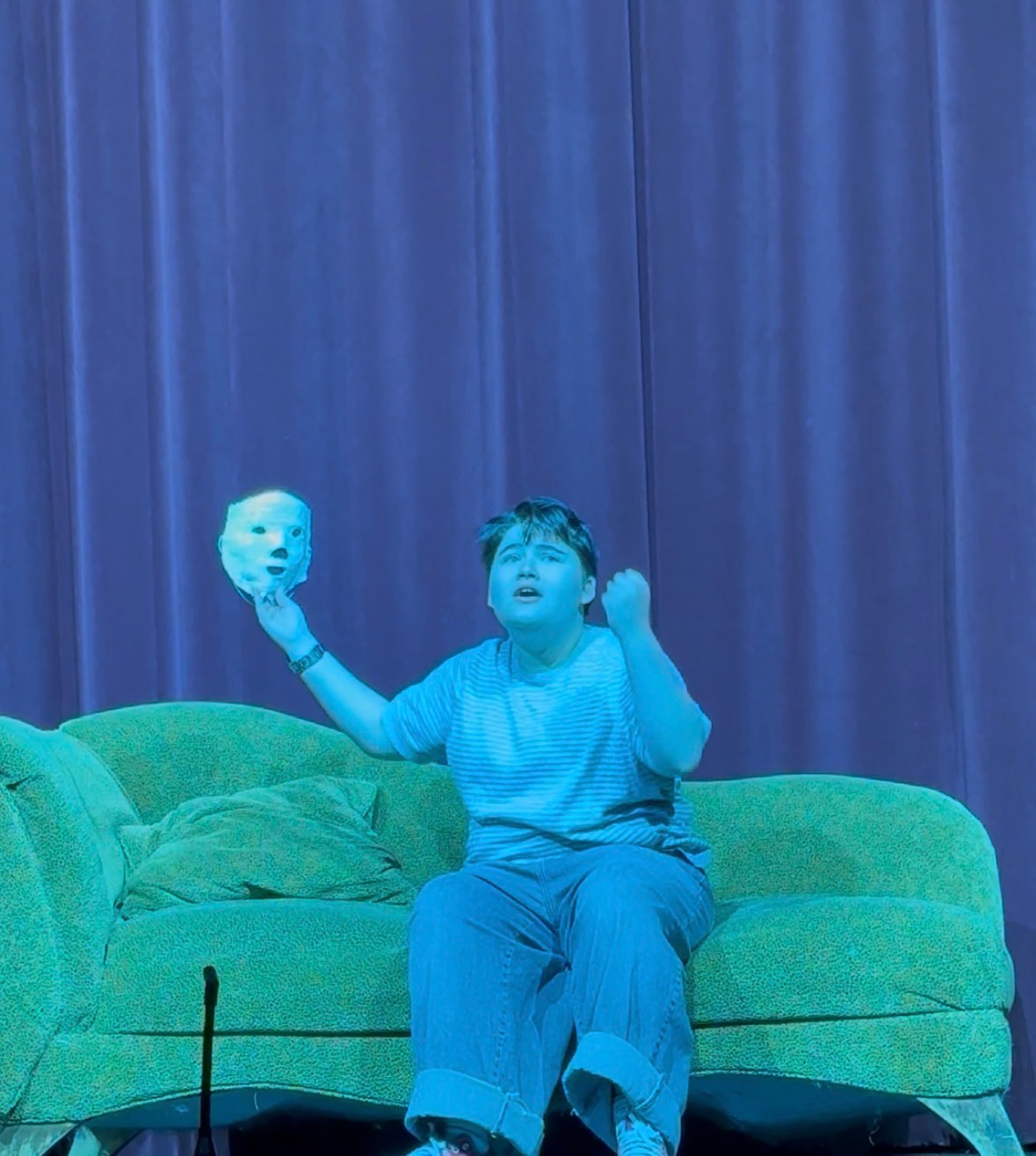
For the majority of student performances throughout the year, audience participation is essential, whether it be singing along to the “Mamma Mia!” musical or laughing during Student One Act plays. Once a year, however, for the International Baccalaureate [IB] Theatre Night, the Newbury Park High School Performing Arts Center requires complete silence, with absolutely no audience reaction to ensure that the recordings come through clear and can be used for their exam.
Taught by Marilyn Strange, the IB Theatre course can either be taken in one or two years, with the IB assessment taking place during students’ senior year. IB Theatre Night took place on March 5 and 6, with collaboration performances on Thursday and solo performances on Friday. For the collaboration project, students divided into groups of two to six people, performing a 7-10 minute original piece. Collaboration performances challenge students to formulate intentions for their pieces, examining the ways in which these intentions can be effectively realized, according to IB.
In preparation for the IB Theatre performance, Kyla Nordhus, senior, has enjoyed the creativity that has been encouraged throughout the process, comparing this type of exam to typical tests she finds herself taking. While students are provided with guidelines on their performance, there is flexibility within creating the pieces. Leading up to the show, Nordhus spent time both in class and outside of school with her collaboration partner to practice the script.
“We finalized our script together, and then we just really focused on developing our characters and getting the lines not necessarily memorized, but how we’re going to say it and how our character would say it. Practicing a collab, a script with somebody by yourself, you can’t really have the same effects, so you have to find the time to work with your partner,” Nordhus said.
Sebastian Hall, senior, is currently in his second year of IB Theatre, and performed his collaboration piece on the effects of suicide and grief. While many performances share the same preparation, such as memorizing lines and creating props, the experimental IB performances pose another step in production. “It can kind of take a little bit of mental preparation to just be like, okay, a lot of it is personal and you’re about to share something personal, not only with the IB assessors, but also with the audience that comes to see the show,” Hall said.
For the solo performances, students chose a theater theorist to focus on, creating their own piece based on influences and aspects of their theorist. All performances were presented in unique ways, each with different lighting settings and prop choices, emphasizing the creativity that students were able to pursue. “You have to do [the performance] all yourself and through your voice, through your tone, through physicality. So I have to really focus on how I’m going to say things and what I’m doing while I’m saying those things,” Nordhus said. “[I have to figure out] how to show the audience, how to convey to the audience just what I’m feeling and the real emotion and meaning of the scene has to be through me and not through the other elements.”
As a unique student within the class, Samantha Vitale is only one of two seniors who is completing the IB Theatre course in one year, meaning she had to complete the requirements in half the time. While this has been a more stressful experience for her, Vitale believes that it has taught her to be more disciplined with her work. “You have to be really good at adapting [and] really good at catching up with everybody else, [as well as] putting in the effort to catch up with everybody else. You almost have to work a lot harder in order to get to the same understanding as everybody else,” Vitale said.
For most, IB Theatre is a two year course, as well as a continuation to the theater track, so students are able to build connections and relationships from their time spent together. While the exam period comes with varying levels of stress, every student is going through similar emotions, allowing students to find a sense of community and understanding. “You really get to connect with your classmates. And you know more than just their name. The whole class is your friend,” Nordhus said.