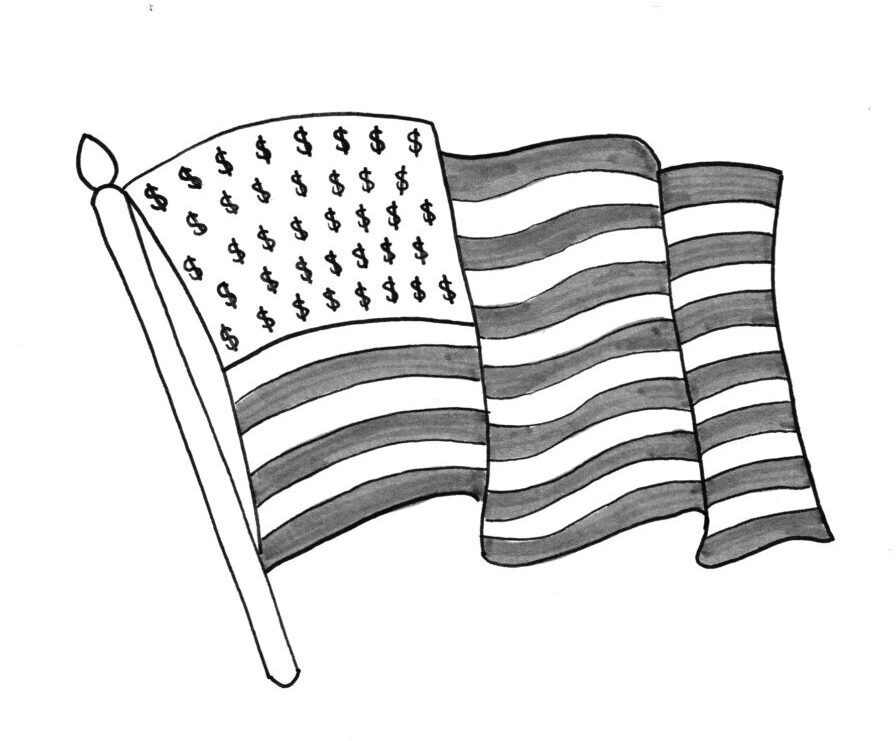
Capitalism has failed our youth, and discussions with my most educated friends reflect fear, hopelessness and disdain for America’s economic system. Capitalism is the economic system based on private ownership of the means of production. It is observable that Generation Z has begun to open their minds to communism, with numerous of my peers viewing it as preferable.
On the contrary, as I learn about the Cold War in history class, I’ve observed the lasting impression that the Red Scare and McCarthyism have had on our nation. Further, as a fourth-generation American with a family that immigrated from the Soviet Union, I have a brief understanding of the nature of communism. Varying opinions on such a complex, controversial, decades-long debate have led me to explore why some of my generation have become entranced by the idea of communism and if there may be a better, tangible solution to late-stage capitalism.
The phrase “late-stage capitalism” describes the current advancement of capitalism in America and is often associated with extreme wealth inequality, monopolistic corporate powers and the struggle to afford daily living.
For instance, Professor Jiang Zuenqin’s popular YouTube lecture, “Capitalism is the Perfection of Slavery,” outlined how interconnected the history of capitalism and slavery is. He summarizes that the government of a capitalist economy indirectly controls its people, as their lives revolve around economic involvement with private businesses that support government parties. For instance, a child goes to school, learning to do well in university, then goes to university, learning to work, then works to afford a home, essentials and luxuries, then shows off such things on social media or at social events. The lower class does not consider revolting against the government run by and supported by billionaires since they are conditioned to spend their lives chasing a livable wage and dreaming of unattainable wealth. Such a concept is often described as “The American Dream,” a false, optimistic piece of propaganda.
Contrarily, communism, a political and economic system aiming for a classless society through public ownership of the means of production, has been a major taboo in the U.S. ever since the Cold War prompted fear and national disdain for the ideology. For some years, my great-grandfather kept in touch with Russian family members, but letters stopped arriving until about a decade later, when a cousin reached out to explain the state of the Soviet Union, which prevented him from contacting my grandfather. The phrase, “ideal in theory, but not in practice,” is commonly used to describe communism.
Back-and-forth election patterns have been studied and observed for decades, reflecting how the political spectrum in America has become so extreme that the right moves toward authoritarian fascism under capitalism and the guise of democracy, and the left moves toward socialism and communist ideals. Though I find it notable that left-leaning politicians do not opt for socialism so much as left-leaning citizens do, I believe most “leftist” politicians in the modern U.S. are more accurately aligned with Reagan-republicanism.
Overall, the rise of self-identifying, young communists and socialists reflects a shift in tides in the left’s reaction to the right’s extremism under the Trump administration.
As a high schooler, it is no surprise that I have yet to discover a solution to the U.S. economy. What I have found is that, despite how hopeless our futures look, community and authentic human connection are what we need to survive. It is essential to dedicate time outside of financial pursuits, focusing on the one thing that can never be packaged, sold and purchased: love.