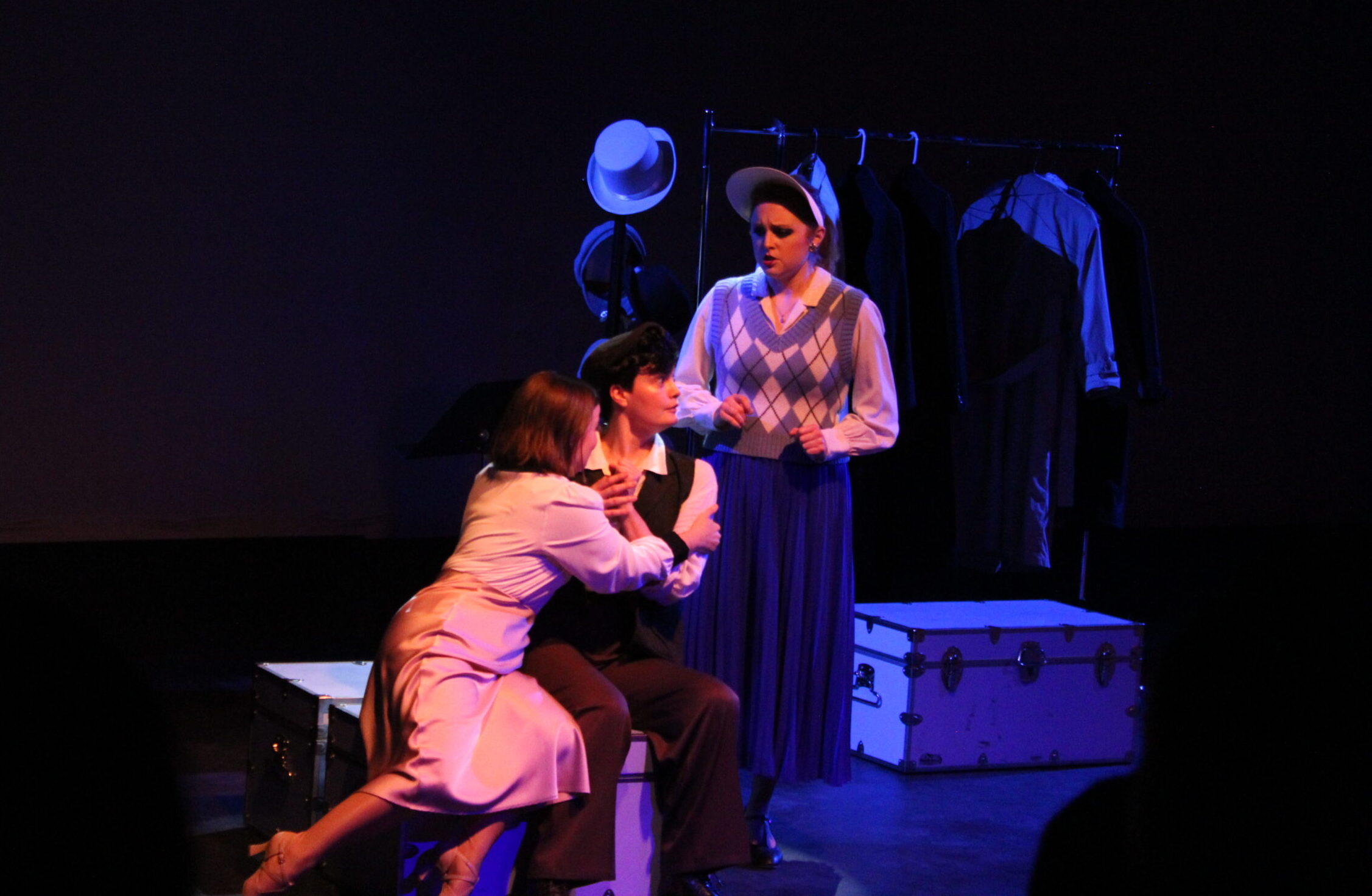
On April 18, local artists put on an hour-long musical adaptation of “The Great Gatsby” by F. Scott Fitzgerald at the Hillcrest Center for the Arts. It was adapted for performance by Bradley Gosnell, a theater teacher at Oaks Christian High School, and Ari Stidham, a television actor. They aimed to make theater more accessible to students whilst maintaining the themes and language of Fitzgerald’s work.
The show begins with the narrator, Nick Carraway, played by Delaney Milbourn, who starts his performance in the audience area. He then starts reading straight from the novel, as if he is in modern day, and is then pulled into the story by the main characters. I thought that this was very useful for the narrative, since Nick is an outsider to the elites in the novel as well. This theme is touched upon through multiple ways. For instance, throughout the entire show, Nick is seen reading from the actual novel, and he must do so in order to progress in the story, whilst everyone else seems to know their lines. Moreover, Nick is then put into his costume by the other main characters at the start of the show, almost as if he is forced into this role.
In addition, I noticed how Milbourn’s voice assimilated into the transatlantic accent as the story went on, which demonstrated the attention to detail that everyone put into this performance. For example, with the actors’ immersive physicality, the scene changes were done seamlessly without having to move any set pieces. I found it interesting that to transition from the lavish city life into the industrial area, there was a man standing with a small billboard of the gigantic, blue eyes of Doctor T.J. Eckleburg.
With the use of a black-box theater and rudimentary set design, the intimate atmosphere emphasized the actors’ physicality, as well as the satire within the show itself. More specifically, in place of driving a car, the actors sat on trunks whilst someone imitated the loud sounds of the engine for comedic effect.
There seems to only be two major musical numbers in the beginning and end. However, I think that this only complimented the story and the director’s bare-bones interpretation of it because of its simplicity.
Since the production was only an hour long, I was pleasantly surprised that the story’s messages were not condensed. The fact that Nick was reading straight from the novel at some points helped with this. While other adaptations of the novel feature extravagant set design and references to the 1920s flapper girl culture to show the wealth disparities at the time, “The Great Gatsby Live!” brings a minimal and intimate take while still preserving the message of the book.