Intro
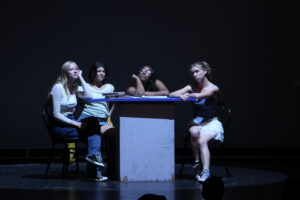
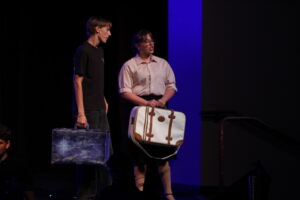
While “Footloose” sets the stage in a town without dance, Newbury Park contrasts through its vast musical productions. Between the original movie in 1984, the Broadway adaptation in 1998 and the movie remake in 2011, “Footloose” is a story which impacts many generations. Bringing the timeless story to life through sets, costumes and song, “Footloose” was performed by the Newbury Park High School [NPHS] Theater Department from Nov. 5 to 8.
Actors
Playing Ariel, the preacher’s daughter, junior Bella Redland’s character has the role of helping Wren bring the spirit of dancing back to her town. Between pre-rehearsal “energy circles” and dance warm-ups, the energy of Footloose’s era builds throughout the Performing Arts Center [PAC].
“Because the movie was made in the ’80s, we have some aspects, like certain dance movies, we are taking from the ’80s to, hopefully, connect to older audiences and relate to the original movie,” Redland said.
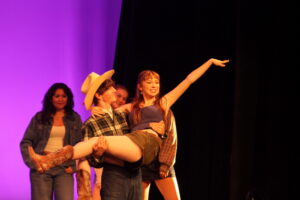
Step, cross, tap. The ensemble prepares to perform the iconic line dance from the original “Footloose” in the closing scene as Redland looks forward to the vibrance of the moves in “Still Walking.”
“The dancing has taken a long time to get where we are today. The rehearsal process has been happening for the past two months, and dancing-wise, there’s been a lot of effort and a lot of work put into the dances, because there’s a lot of numbers, and it’s very dance heavy,” Redland said.
Nynke Heerma, sophomore, has an ensemble role in Footloose, which allows her to see each department’s research and preparation process when producing a musical in a different time period.
“Every single department- there’s costumes, tech, sound, lighting …they all do a lot of research into what different things would be happening in this time [for] what makes sense for the show and the vision and stuff…there’s a lot of research and work that goes into making [Footloose],” Heerma said.
The departments use their research to create specific elements that all together build a transportable, real-world feeling, making the audience invested not only in the storyline, but in the characters too. When accomplished, a musical can evoke a myriad of emotions from Act One to curtain close.
“I would want the audience to feel very immersed; be able to laugh and have fun and just leave [the present], but also, moments where they’re like, ‘wow, I felt that way before,’ or ‘I felt that emotion,’ or ‘I’ve been in that situation,’ and be able to walk away feeling like it was an enjoyable experience,” Heerma said.
Tech Crew
Music and background audio is an essential part of the show, sound head Catherine Oliver, senior, works behind the scenes to connect the audience to the actors.
“Sound typically brings the show together by using different sound effects and background audio to create an ambiance,” Oliver said. “For example, the actors are outside in a scene, and it’s nighttime; there’ll be crickets in the background, and so it’ll feel almost as though you are outside actively with the actors.”
The tech crew is the reason the show runs, starting before the show begins until after the last certain closes.
“During a show, we typically start about an hour before showtime. We start micing our actors, and then I will be on board doing EQ [Equalization] as well as sound check, making sure that all the mics and wires are efficient. And once that’s finished, we make sure all the actors are muted, so that way we can’t hear anyone backstage,” Oliver said.
Winter Morrow, senior, bridges the gap between tech crew and performance by serving as the co-head of costume design and playing the character of Coach Roger Dunbar.
“[I will capture the role of Dunbar] by memorizing all of my lines and making sure I have everything locked down, by bringing my own spin on it, kind of my own energy and my own creativity to my character, into what I put into the show,” Morrow said.
Aside from preparing for the performance, Morrow also spends her time organizing and altering costumes for the production.
“We love to pull a lot of things from our own costume room. And then we also have actors bring in their own clothes; it’s great because everyone can wear their own things. And it actually fits. We also do a lot of seam ripping, which is just like taking out things and taking things out and sewing some buttons on. We love to sew,” Morrow said.
Beyond the costume and acting preparation, Morrow also noted the unique atmosphere and visual style of the Footloose setting.
“[What sets Footloose apart from other musicals is] honestly, the colors. For Chicago, it’s very bright and very lively, while in Beaumont, where [“Footloose” is set], it’s very rustic, very sad and gloomy. Like, no joy in it. So the fun colors stood out to me the most,” Morrow said.
Directors and choreographers
Bringing a musical to life takes more than what the audiences see on stage. Behind the production of Footloose, Marilyn Strange, theater director, and Cameo Carolyn, dance choreographer, work together to bring the script to life.
Strange, who develops the vision for “Footloose” understands the widespread impact first hand as she works behind the scenes to bring the show to life.
“I wanted it to feel timeless. It’s about a time period in somebody’s life where they’re experiencing that event. And that can happen on anybody’s timeline. An old person like me, or high school students like you, or even younger. And it’s tapping into that life event is what we’re after,” Strange said.
Alongside Strange’s direction, Carolyn works to incorporate dance moves to fit the no-dance law within the town of Beaumont during “Footloose.”
“I still have to create these dance numbers that aren’t dance-driven. So using a lot of pedestrian movement or physical education movement, one takes place in a gym, is trying to literally stack PE moves on top of each other that go with the music, but it doesn’t look like dance [which is] hard,” Caorlyn said.
Strange incorporates elements of the 80s aesthetics to give homage to the original movie.The vibrant colors and visual details helps capture the energy and style of the decade.
“We’re adding in some fun 80’s influence, like, big, crimpy hair, or some neon colors. The colors for the advertising we went with were bright pink, hot pink, and purple. So that sense of the vibrant color scheme of the 80’s,” Strange said.
“Footloose” opens the door to musical experimentation.
“I think it’s allowed the students to explore their creativity and their artistry in a different way than we’ve had in the past. And it’s been really neat to watch it grow and evolve since we first started,” Strange said.
Conclusion
The curtain drops and the crowd cheers. After selling out three times, the story of “Footloose” is shared between young and old. While the show may be over, preparation for the next play will begin soon.
“The original storyline is still intact in our show. If everyone just works together, the show will look really good, and hopefully, a lot of the older audiences will appreciate it and get excited,” Redland said.
Leave a Reply