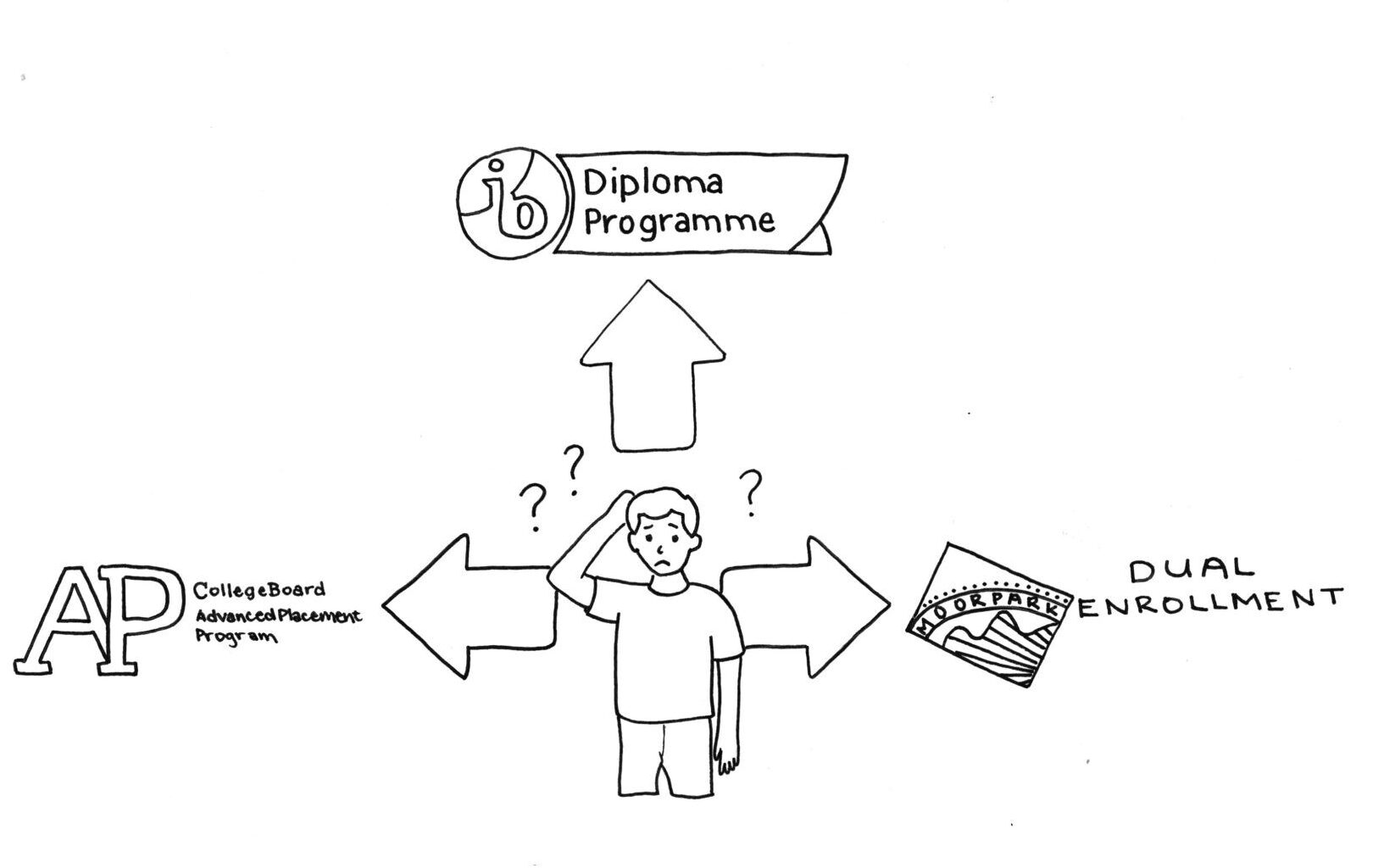
As students decide their classes for the following years, information about credits and requirements can be dispersed and confusing. Newbury Park High School [NPHS] offers a variety of classes, including International Baccalaureate [IB], Advanced Placement [AP], Special Education, Digital Arts and Technology [DATA] and College Prep [CP]. Students also have the opportunity to take dual-enrollment classes through local community colleges to earn both high school and college credits. With the variety of courses and academic pathways available, information needs to be accessible to help students determine and meet their goals.
A significant difference between IB and AP classes is that most AP classes allow students attending Moorpark Community College and other community colleges the opportunity to earn college credit if they score a three, four or five on the cumulative AP exam. Alternatively, for the most part, IB credits do not transfer if they are considered Standard Level or if a student has completely received an IB Diploma, even though Standard Level classes are still time-consuming and demanding. This is especially frustrating considering that IB classes are objectively more rigorous than AP classes, and that they are, for the most part, two-year classes, whereas AP classes are only one year long. The amount of effort required to take an IB class and perform well on the days-long IB exam seems much less rewarding, knowing that credits do not transfer to Moorpark Community College, which many students do not understand or are never told. This is why many students choose to pursue dual enrollment to earn college credits, as it is seen as more valuable, considering the credits are transferable.
Meanwhile, in talk among peers, it appears as though college counselors’ and teachers’ opinions and advice regarding dual enrollment differ, causing students’ schedules to vary dramatically without a clear reason. Some students take core classes through dual enrollment, and others are not even registered for dual enrollment. Information that is key to deciding which category of classes to take must be sought out by students, but it seems as though counselors are biased when providing recommendations, giving differing advice on what schedules should look like and what colleges want on students’ transcripts. The lack of continuity in information when signing up and applying to courses is confusing and stressful for students.
Beyond the frustration of earning college credits, a major concern with IB or AP exams is the cost. One IB exam costs around $120; for students who are full IB, this means that they are expected to pay almost $600 for their exams. The sheer cost of these exams is a major barrier for students whose families are low-income. If a family qualifies for the free and reduced meal program through CVUSD, which is offered for low-income families, students are able to take IB tests for a discounted price of $5 per test. However, to qualify for free and reduced lunch, a family of four must have a yearly income of $59,478 or less. This presents the same problem for many students when trying to gain financial aid for college, in which their family makes an income that does not qualify them for aid, such as free and reduced meals, but still does not have a high enough income to have hundreds and hundreds of dollars to spend on IB and AP tests.
The major dilemma behind AP and IB testing is that if students received these credits, they could possibly clear a whole semester of college classes, avoiding paying $40,000 or more. This presents a major issue of accessibility: all students should be able to access IB or AP classes, but the cost plays a major factor in their decision to enroll in these classes. When students select their classes for the next year, they do not receive a notice about the cost factor, potentially leading to a student taking the class, yet not being able to clear prerequisites through taking the test.
While dual enrollment may be considered an alternative to IB or AP classes, there is still a lack of face-to-face education and skills that can only be gained in the classroom. There is also a debate about whether dual enrollment classes are as valuable for college admissions; it depends on which colleges one is interested in, as some value dual enrollment more than others. The confusion caused by a lack of information regarding whether dual enrollment classes will benefit or harm students’ admissions causes confusion among students, making this process frustrating.
Like students, studying to pass exams and applying for next year’s classes, NPHS’s counselors and staff are busy at work in these last few months of school, as well. Rather than a student needing to take the steps to reach out to their counselor, available resources, or information to find such resources, are made accessible to students, such as resources regarding which credits will transfer or not, and what classes colleges do or do not want to see taken through dual enrollment, through the counseling website. However, that is not widely known, and students often end up feeling misguided and confused.
Overall, the lack of comprehensible advice and information regarding course credits while signing up and applying for classes causes discrepancy, confusion and stress. The Panther Prowler staff encourages students to research the counseling website and read pages 8-9 of this issue to gain a more meaningful understanding of the credits they’re working toward.