Comfort lies within conformity. As a child, I often felt embarrassed by what made me different and separated myself from my peers. For the entirety of my life, I have never felt like I truly belonged where I was, so I would do anything to abandon any identifying factor that could be interpreted as “unique.”
Music has constantly filled every room I’ve walked into. Music was my first conscious connection to my culture. Before I was able to coherently verbalize the complex labyrinth of my inner thoughts, I could express myself through dance, a direct reaction to the music being played around me.
As a child, when a friend from school would come over, I’d hide away my children’s books written in Greek and my non-English CDs. I wanted to hide all aspects of myself that could potentially be seen as “weird” or “different.”
As a child, I used to dread the mundane ritual of my teacher calling names to mark attendance. Manually, one by one, in alphabetical order, the names of each student would be called. As my teacher’s monotone voice droned closer and closer, a veil of anxiousness draped over my face and covered the entirety of my body. I hated having a last name that was difficult to pronounce; a last name directly tied to a culture I tried to banish. My name served as a current reminder that I was culturally different from those around me, and that no actions I could take would be able to extinguish my Greek heritage. My first name, “Athena,” also served as a constant reminder that I was different from my peers. I was named after Agia Athina, a venerated martyr in the Eastern Orthodox faith, to honor and follow in her memory. My first name symbolically represents strength and wisdom, which I ironically felt I lacked for the entirety of my life.
From my very first baptism, the Greek Orthodox churches of Southern California have all become my second homes. I was baptised under the name “Sophia.” In Greek, Sophia translates to wisdom, which directly connects with Athena, the Greek Goddess of Wisdom. Sophia was also intentionally chosen to honor my grandmother, my yiayia’s name, so I was named in her image.
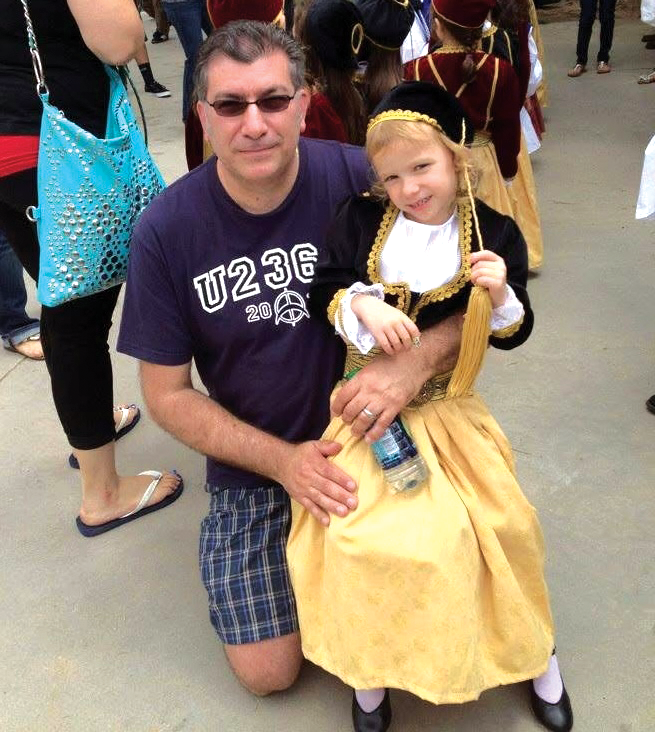
Before I could truly walk, I danced. Greek dance is a general term for different specialized dances collected from Greek islands, which have been passed down from generation to generation. For me Greek dance is a way to not only honor Greek culture, but to also connect with my peers.
In a desperate attempt to fit in with my friends from school, I took a dramatic hiatus from Greek dance. I often proclaimed to my family with a complete unwavering certainty, as many 7-year-olds do, that my Greek Dance career had officially ended.
In retrospect, I find it humorous how I was in a constant search for my personal identity, and in an attempt to find who I was, I attempted to disregard my culture and mindlessly conform to those around me. I was so young and confident, yet so naive and uneducated.
In an act of defiance against my culture, I quit Greek Dance for a year and joined a local softball team. My softball career was unfortunate and short-lived. My strengths did not lie in softball; I was subpar at batting and not fast enough to be a sufficient runner, so I channeled my energy into cheering my teammates on from the bench.
After a year of no Greek Dance, I felt lonely and disconnected from my peers. I felt as if I was watching the happy Greek children of my church through a window. I stood outside looking in at them, as they looked intently at each other.
I often felt a divide from my friends due to my religion. For at least one day a week, I was reserved by the Greek Orthodox Church. I have had to miss countless birthday parties and events hosted by friends due to my commitment to attending church.
In the earlier stages of my youth, I used to dread going to church. I felt obligated to physically be present in church, for my body to literally sit inside the seemingly endless rows of mahogany pews. I longed for a life of freedom. My mind wandered to the countless activities I could be doing instead, but these desires never fulfilled me. Being absent-minded during church processions often left me feeling empty.
.To follow in the footsteps of my yiayia and my older sister, I was a debutante in the biannual Debutante Ball hosted by Saint Sophia, the Greek Orthodox Cathedral of Los Angeles.
Through my time as a debutante, I learned fundamental cultural practices that made me feel proud of my cultural heritage. I learned how to make prosforo, communion bread, alongside my peers, which instilled the importance of sharing traditions down from one generation to the next. Being a debutante made me excited for my future in the Greek Orthodox Church. I want to live a life like the strong women in my faith who have surrounded me for the entirety of my life.
In a blunt generalization, to be Greek is to be loud, exuberant and passionate. Through all of these aspects of my Greek culture, from sports to my faith, I have grown to appreciate all aspects of my heritage.
But truly, the reason I stand proud today in my Greek culture is my dad. I hope to follow in my dad’s example. As a child, I was “forced” to participate in Greek Dance and basketball, attend church weekly, under the authority of my dad. Now I can thank him for often encouraging me to venture out of my comfort zone and immerse myself in aspects of my culture I would have avoided and abandoned without him.