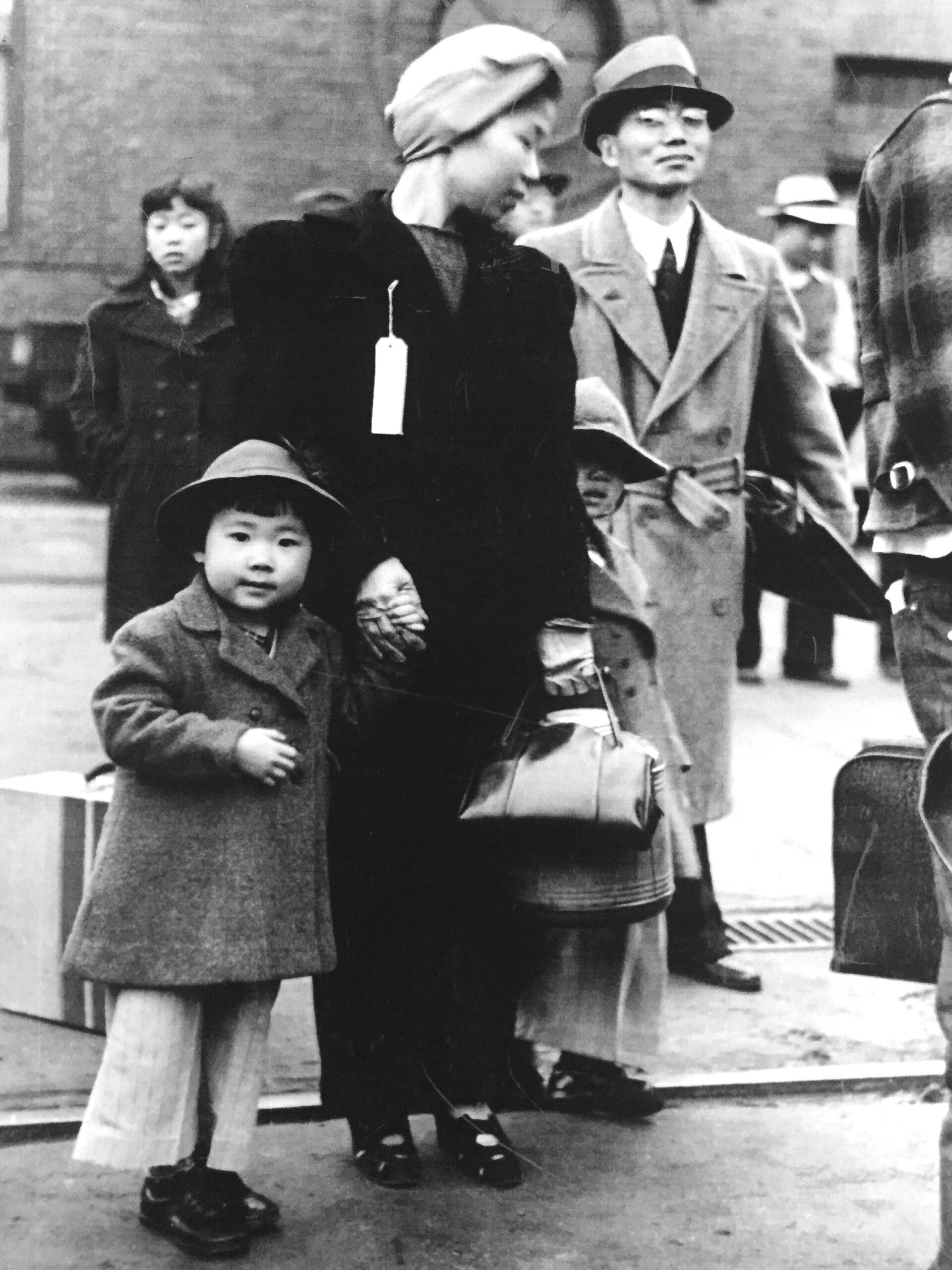
Sharon Kodama’s earliest memories consist of soldiers wielding guns, the orphanage in which she lived for four years and barbed wire. Following Executive Order 9066 in 1942, issuing the relocation of over 120,000 people of Japanese descent, 3-year-old Sharon Kodama and her family were taken from their home and sent to Manzanar, a Japanese internment camp in California.
Sharon Kodama grew up in Long Beach, California, where her father owned a successful restaurant. Her mother was born in Washington but raised in Japan, and her father moved to the United States at 12 years old where he was educated and learned English. “The restaurant was doing really well, and he had just bought a new Packard…equivalent to a Cadillac or a Mercedes Benz at that time,” Sharon Kodama said.
When the U.S. joined WWII, Sharon Kodama’s family was taken from their home to Manzanar, which was packed with over 10,000 people in barracks with no privacy and poor sanitation. Within a few months of living in the camps, Sharon Kodama’s father unraveled, killing her mother and taking his own life. Sharon Kodama and her sister were sent to the camp’s orphanage.
Even worse than the living conditions was the loss of pride and honor that many Japanese Americans experienced. Over two-thirds of those interned were American citizens, and 26,000 were serving in the military while their family was interned.
Sharon Kodama was 7 years old when she was released in 1945. Her aunt and uncle took in her and her sister, as they had been fortunate to live far enough away from the West coast to avoid relocation. “[The transition] was really easy. I remember my aunt [gave] me a Sears Roebuck catalog, and she says, ‘I want you to circle seven things you want for Christmas,’” Sharon Kodama said. “At Christmas, I looked under the tree and there were all seven of them.”
Although her aunt and uncle’s generosity made it easier for Sharon Kodama to adjust back to a normal life, she still had to live with the racism that proliferated following the war. The derogatory word “Jap” was plastered on businesses and signs, and part of blending into American society meant changing her name from “Shizuko” to her English name, “Sharon.”
Years after her internment, Sharon Kodama raised her five kids in West Hills, California. Although the war had long ended, her children, Michelle Larson, Matt, Mike, Mark and Rob Kodama, faced harassment and racism due to their ethnicity growing up in a primarily Caucasian area. “We were Japanese Americans living in a white society. We weren’t a part of that society, and we weren’t sure about the other side either,” Matt Kodama said. “So we spent most of our time a little bit lost.”
The Kodamas also struggled against school curriculums that had very little detail about the camps. “My oldest brother Mike, when he was in high school, actually had a slight debate with a teacher over [Japanese internment],” Larson said. “The teacher was in disagreement with [the] severity which people don’t talk about, or are not telling you the truth [about] or trying to hide something, [and with] something as powerful as our government, that’s what happens.”
As Sharon Kodama’s children grew older, so did their curiosity about the camps. When the Redress Movement, the push for reparations, gained traction, the Kodomas helped advocate. “[We pushed] for the principle of it, the money was not a big deal,” Sharon Kodama said. “It was the formal apology that was nice.”
What was most important to Matt Kodama was the government’s acknowledgment of its clear violation of human rights. “The Redress Movement was important because in the Constitution you could sue the government for wrongdoing. It took all those years, but by the late 80’s, they acknowledged it. So I think that, in a lot of ways, is a big victory,” Matt Kodama said. He sees the Redress as something that the government should honor for all American citizens. “The trend now, just to capture women and children and deport them, or imprison them, like they did with [my mom]—it has to come around again. It’s constitutionally not acceptable,” Matt Kodama said.
The Redress Movement was successful in 1988, and encouraged the Kodamas to share their mother’s story. Her grandson, Brett Kodama, created a short film titled “1217,” a tribute to Sharon Kodama being number 1217 out of over 120,000 Japanese Americans in the camps. The film has since traveled and won prizes, and Larson believes it has been educational to many who have not been exposed to this history.
When sharing her mother’s experience with others, Larson places herself in her mother’s shoes. “People suffered not only financial devastation, but personal property, personal pride, probably faith in the United States in which they were living, I think you would feel betrayed… You just look [Japanese] and all of a sudden you’re this criminal and you’re this bad person,” Larson said.
Growing up with her mom’s story, Larson understands the importance of learning from history. “Our government, the United States, is far from being perfect. But I think that [in] your generation, my kids’ generation, hopefully people can continue that fight, that promotion of peace and well being and accepting of others and building [of a] better generation,” Larson said.
Time has taught Sharon Kodama more about her history and family, and her curiosity has been passed down to her children, who continue to seek answers to the questions about her childhood. “You don’t know why everybody’s in Manzanar, why you’re living like this, and you don’t compare it because you’re only 4 years old,” Sharon Kodama said.